The International Eucharistic Congress is taking place in Hungary these days; it will be concluded on Sunday 12 September 2021 by Pope Francis. On this occasion, exactly on September 10, 2021, at 7.30 pm, in the Main Concert Hall of the F. Liszt Academy of Music in Budapest, the Eucharistic Symphony by P. Armando Pierucci will be performed.
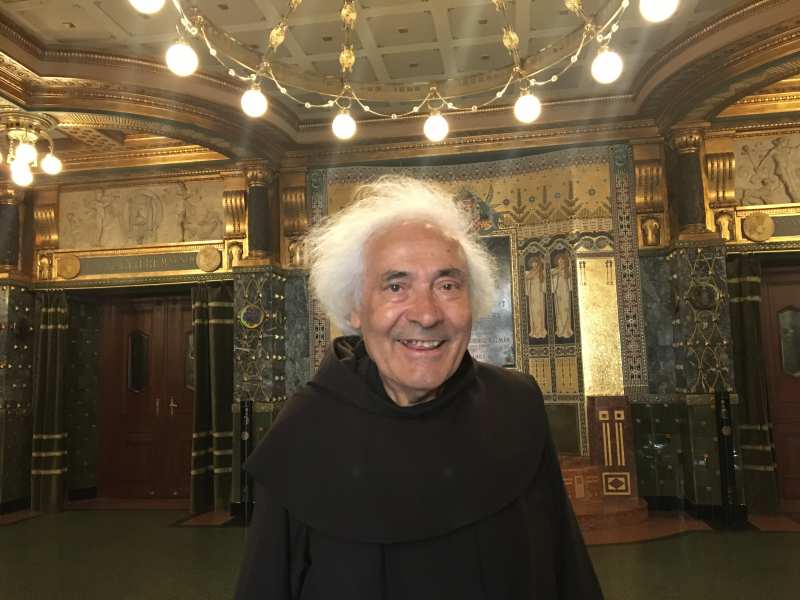
The Eucharistic Symphony was born in 2011 from a suggestion of Arnaldo Mosca Mondadori, then President of the "G. Verdi" Conservatory in Milan: "Why, Mosca Mondadori asked the Franciscan, don't we have a Mass with all the twelve Christian Confessions that are in Jerusalem?"
"It does not depend on the musicians", replied P. Armando; "at most I could take songs from the individual Confessions and develop them symphonically: with soloists, choir, orchestra".
Mondadori Mosca picked up the phone and told the director of the Matera Conservatory of Music, Saverio Vizziello:
"Jesus told me that you must perform the music that will be composed in Jerusalem. It is an important thing for Christian Unity; Matera has an ecumenical tradition. You must do it."
And so it was. Fr. Pierucci went to the Churches and Convents of 12 Christian Confessions in Jerusalem, asked for their characteristic chants, and elaborated everything in a vision that was easier to hear to Western culture. He thus created an ideal Eucharistic Celebration, in which the various liturgical moments, preceded by a Prelude on a Jewish theme, are expressed by the singing of each of the 12 Churches.
The Eucharistic Symphony was performed on 22 September 2012 in the Garden of Gethsemane in Jerusalem and broadcast on TV 2000 and many Christian TVs around the world. Within a week it was then performed under the patronage of the Apostolic delegation to the United Nations in Geneva in the presence of about 1500 guests, as an expression of religious freedom. In this case, a passage on an Islamic theme has been added. Two days later there it was performed in the Milan Duomo and then in Matera. In 2013 it was performed in Turin in the sanctuary of Mary, Help of Christians; in 2014 in the Budapest Cathedral.
The Hungarians remembered this and now, convinced that if Christians cannot celebrate a Mass together, at least they can sing it, they repeat the performance of the Eucharistic Symphony by Fr. Armando Pierucci.
The Laus Plena Foundation is involved in this event, in coordination with the Hungarian Franciscan Province, in particular the Foundation organized a professional recording of the concert, in view of the publication of a CD.
https://www.iec2020.hu/en/program
https://www.iec2020.hu/en/program/eucharisztikus-szimfonia
FRIDAY, 10 SEPTEMBER
Time 19: 30 - 21: 30
Location Liszt Academy
Liszt Ferenc tér 8. Budapest 1061 Hungary
P. Armando Pierucci OFM
The symphony draws on the traditional music of twelve Christian churches living side by side in Jerusalem, with passages usually sung in the Eucharistic liturgy. These inspired the twelve movements of the symphony.
The result is a piece of music that, while having Western characteristics, enters into dialogue with different cultures and eras, including ancient Armenian, Byzantine, Syriac-Aramaic, Ethiopian and Coptic musical traditions. The symphony also incorporates musical modalities that are now only preserved in Eastern traditions. In order to preserve the liturgical authenticity of the original music, the movements begin with a cappella performances of melodies preserved intact in the Eastern churches by twelve singers representing each Christian confession, followed by an orchestra and choir to unfold the theme.
The interplay of the different ecclesiastical traditions gives the Symphony not only a very unique musical sound, but also a deep spirituality.
Conductor: András Virágh
Soloists: Zoltán Megyesi – tenor and Kinga Sirákné Kemény - soprano.
Contributing:
Budapest Strings, concert master: János Pilz, artistic director
Károly Botvay Saint Ephraim Choir, artistic director: Tamás Bubnó
Saint Angela Choir, conductor: Dr Gabriella Semjénné Menus
Representatives of the 12 Christian churches, including guests from the Holy Land
EUCHARISTIC SYMPHONY
Armando Pierucci
Introduction
“Ashrei” (Ebraic tradition)
Movements
THE EUCHARIST SYMPHONY PROJECT AND THE THEME OF THE EUCHARIST
The Symphony gathers pieces from twelve different Christian traditions represented in Jerusalem, usually sung during the Eucharistic liturgy. These have inspired the twelve corresponding movements of the Symphony, which starts with an introduction on a Jewish theme.
The result is a musical composition, which, though Western in character, interacts in a dialogue of cultures and times with the ancient musical traditions that inspire it: Armenian, Byzantine, Syro-Aramaic, Ethiopian, Coptic, etc. In fact, it includes musical modalities that are now preserved only in the Eastern traditions. Also, in order to appreciate the liturgical authenticity of the original pieces, conserved with love and respect and handed down in centuries in the Eastern Churches, these are sung “a cappella” by twelve singers of the Churches represented, before the orchestra and the choir perform their Symphonic development. In the East, liturgical chanting is very elaborate and is often solely monodic and vocal, as it was originally in the West.
This interaction of the different ecclesial traditions does not only make the Symphony very special, if not musically unique, but also gives it a high spiritual value. The Christians of the first centuries used to describe the "Body of Christ" - the Body born from the Virgin Mary, the Eucharistic Body and the ecclesial Body of Christ with the same word. The Symphony is an invitation to contemplate the great Mystery of the Communion of the Church, so rich and diverse, this Mystical Body that breathes with its Eastern and Western lungs and whose members all live from the Body and Blood of Christ-Eucharist. A Mystery of overwhelming beauty, a gift of the Holy Spirit to the Christian community.
Donations on bank account at UBS Switzerland AG in the name of: Fondazione Laus Plena, Lugano.
The Foundation issues certificates of donation for tax deduction purposes.
Bank details. See below.