
The various Christian Churches are first and foremost the expression of the cultural diversity of the populations that have assimilated Christianity. This also included the relative musical traditions, then resumed in the sacred music of the Churches. We present the various Christian Churches through a series of short documentaries, co-produced by the Custody of the Holy Land and by V. Nebel, a member of the Council of the FLP.

The Syriac Catholic Church stems from the Patriarchate of Antioch, a cosmopolitan city of the ancient world with a refined mix of Aramaic-Semitic and Roman-Hellenistic cultures in the region of today’s Syria and Turkey. There, the expansion of the new faith started in the first century: Antioch was evangelized by the Apostles Paul and Barnabas, and Saint Peter resided in the city in 37 AD. Antioch was recognized as a Patriarchal See with Alexandria, Rome and Jerusalem in 325 AD, and played a very important role in Christianity in the first centuries, fighting the first heresies. At the Council of Chalcedon in 451 AD, a now outdated theological dispute caused the progressive division of the Church of Antioch, both internally and externally, from the Churches of Rome and Byzantium. The Syriac Catholic Church emerged much later from the Syriac Orthodox Church of Antioch, in the 17th century, from the desire of some of the Syriac bishops to be united and in communion with the Roman Catholic Church.

Founded around the year 400, the Maronite Church is distinguished by being the only Eastern Church that has remained in full communion with the Roman Catholic Church over the centuries, without any division or splitting. Its origins lie in the Church of Antioch, the city where “for the first time the disciples were called Christians” (Acts 11: 26). It is also the only Church named after a saint.
Within the Catholic Church, the Maronite Church has maintained its peculiarities: first of all, it has its own ancient Eastern rite and a liturgy of its own, anchored in the Syro-Antiochian tradition, which best preserved the language and customs of the first apostolic community: part of the liturgy is still carried out today in Aramaic, or Syriac, the same language that was spoken by Jesus, and is otherwise held in Arabic.

The name “Anglican” means “of England”, but the Anglican Church exists worldwide, with ca. 80 million Anglicans across the world. It is the third largest Christian communion in the world, after the Roman Catholic Church and the Eastern Orthodox Churches.
The Anglican Communion is organized as an international association of Churches consisting of the Church of England and of national and regional Anglican Churches with full autonomy and in communion with it, specifically with its principal primate, the Archbishop of Canterbury. As the religious head of the Church of England, he has no formal authority outside that jurisdiction, but is recognized as symbolic and spiritual head of the worldwide communion and is considered, among the other Primates, as primus inter pares. He chairs and presides the “Instruments of Communion”: the meeting of the Primates, the Anglican Consultative Council.
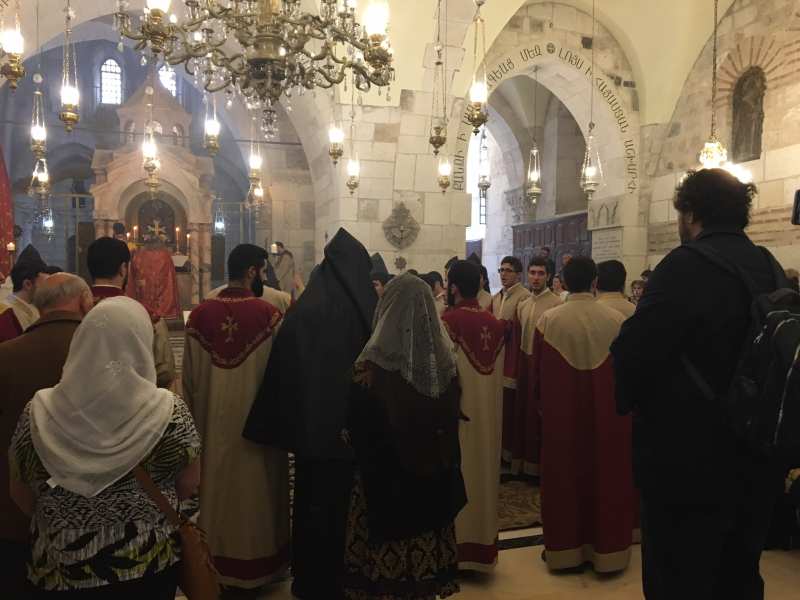
"In origine, la musica della Chiesa armena veniva cantata all’unisono, con una sola voce. E fino ad ora, in alcune parti della Chiesa armena, la tradizione viene mantenuta. All’inizio del XIX. secolo, le nostre liturgie sono state sviluppate e armonizzate per cori misti. La tradizione della Chiesa armena è stupendamente ricca, abbiamo molti inni, poi c’è un bellissimo spirito di adorazione."
Donations on bank account at UBS Switzerland AG in the name of: Fondazione Laus Plena, Lugano.
The Foundation issues certificates of donation for tax deduction purposes.
Bank details. See below.